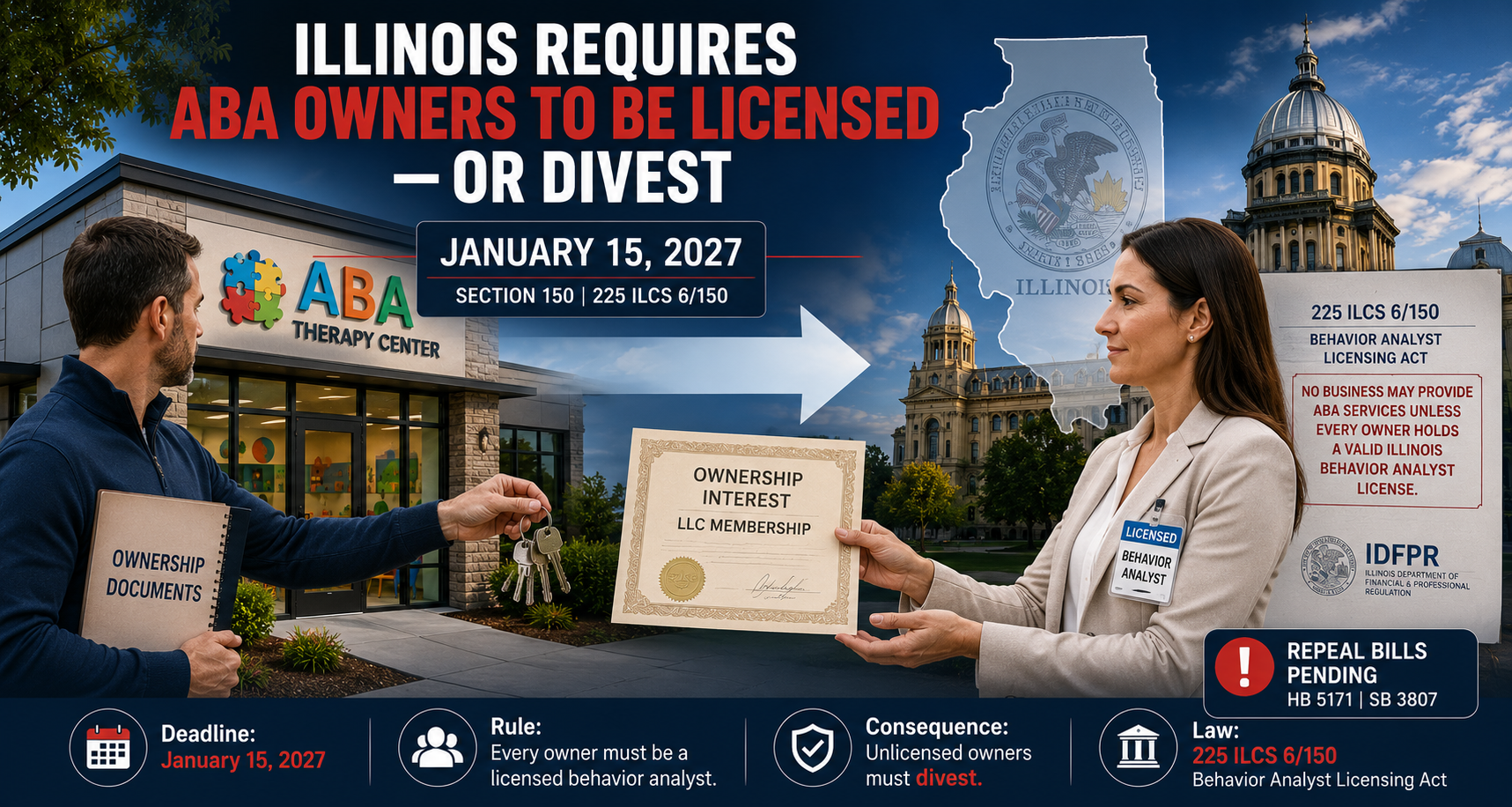
Repeal bills pending, but the divestment clock keeps running
Read the full entry belowIllinois is one of only two states, with New York, that require an ABA business to be owned by licensed behavior analysts. The requirement lives in Section 150 of the Behavior Analyst Licensing Act, 225 ILCS 6/150, passed in 2022.
The rule is strict. Beginning 24 months after the state started issuing licenses, no business organization may provide applied behavior analysis services unless every member, partner, shareholder, director, officer, and holder of any other ownership interest holds a valid Illinois behavior analyst license. The Department of Financial and Professional Regulation began issuing licenses on January 15, 2025, which set the deadline at January 15, 2027. The department states the consequence plainly: an owner who is not licensed by that date must divest from the business.
The exposure is broad. A survey by the Council of Autism Service Providers found that among responding Illinois providers, 60 percent were not fully owned by licensed analysts. Many of these are established practices, some operating for a decade or more, built long before the requirement existed.
There is one live complication that changes the calculus. Two bills before the General Assembly, SB 3807 and HB 5171, would repeal Section 150 and replace it with a narrower rule barring only unlicensed clinical decisions. If either passes, the ownership mandate disappears. If neither does, the deadline stands. The trap is timing: restructuring reportedly takes about six months, so an owner who waits to see whether the repeal passes may run out of time to restructure if it fails. This dossier tracks both the deadline and the repeal effort.
Timeline, newest first
- 2026-07-15Live
Repeal bills pending, but the divestment clock keeps running
225 ILCS 6/150With roughly six months to the January 15, 2027 deadline, Section 150 remains in force. Two repeal bills, SB 3807 and HB 5171, are pending but have not passed, and the ownership mandate stays law until they do. Because restructuring an ownership stack reportedly takes about six months, an owner who is waiting for the repeal is now at the point where waiting and restructuring become mutually exclusive. The prudent reading is to plan for the deadline as if the repeal will not happen, and treat any repeal as upside rather than as a plan.
- 2026-02-01
Repeal effort introduced: SB 3807 and HB 5171 Source: Illinois General Assembly, HB 5171 status
Illinois General Assembly, HB 5171 statusTwo bills were introduced to repeal Section 150 and replace it with narrower language. Rather than requiring licensed ownership, the bills would provide that any owner, officer, agent, or other equity holder who makes clinical decisions regarding patient care without a license violates the Act. The bills also amend the Professional Service Corporation Act and the Professional Limited Liability Company Act to add applied behavior analysis to the professional services that licensed analysts may combine in a single professional entity. The Illinois Association for Behavior Analysis opposes repeal; the provider group IPAAQ supports it. The outcome is unresolved, and until it resolves, the existing ownership mandate governs.
- 2026-01-01
Section 150 becomes law Source: 225 ILCS 6/150
225 ILCS 6/150Illinois enacted the Behavior Analyst Licensing Act with Section 150, requiring that every owner and equity holder of an ABA business hold a valid state license, and that such businesses organize under the Professional Service Corporation Act. The provision drew little attention at passage. Its practical force was deferred to a future date tied to the start of licensing, which is why an ownership mandate passed in 2022 becomes a live divestment deadline in 2027.
ABAWiser provides research, analysis, and compliance advisory services. We are not a law firm, we do not provide legal advice, and no engagement creates an attorney client relationship. Dossiers track developments as they occur and may be incomplete or updated as a story evolves. Confirm any statutory or regulatory point against the primary source before acting on it.